


Your current location:Home > Events > Workshop on Marine Issues


On May 12, the 2026 International Workshop on Juncao Technology officially commenced in Fuzhou. The event is hosted by the 21st-Century Maritime Cooperation Committee and co-organized by the Foreign Affairs Office of Fuzhou Municipal People’s Government and the National Engineering Research Center of Juncao Technology at Fujian Agriculture and Forestry University (FAFU).
Marking the fourth consecutive year the Committee has organized an international workshop to promote Juncao technology, the program has attracted 20 delegates from nine nations, including foreign members of the Committee, representatives from Fuzhou’s friendship cities, and delegates from South Pacific nations. Gathered in the “City of Blessings”, participants will use Juncao as a bridge to share their vision for green development and strengthen bonds of friendship.
Juncao as a Medium: The “China Solution” Benefits the World
This year marks the 40th anniversary of the invention of Juncao technology. In 1986, Lin Zhanxi, Chief Scientist of the National Engineering Research Center of Juncao technology and professor at FAFU, invented the technology in Fujian Province, achieving the groundbreaking substitution of grass for wood in mushroom cultivation. During his tenure in Fujian in the 1990s, President Xi Jinping spoke highly of Juncao technology and personally promoted its development. Since then, he has continued to support the application of Juncao technology across developing countries. Today, this “China Grass” has taken root in 108 countries, serving as a hallmark of China’s foreign aid and global poverty reduction efforts, as well as a practical initiative supporting implementation of the UN 2030 Agenda for Sustainable Development.
As a specialized committee within the framework of the United Cities and Local Governments Asia-Pacific, the 21st-Century Maritime Cooperation Committee is committed to building an important platform for maritime cooperation under the Belt and Road Initiative. The Committee now comprises 80 members from 29 countries. Since 2023, it has organized four consecutive international workshops on Juncao technology, training nearly 100 technical professionals from 19 countries and continuously deepening cooperation in agricultural technology, ecological governance, and green development. These efforts have gradually built a “Juncao cooperation network” spanning the South Pacific and extending across the globe.
Relevant official of the Foreign Affairs Office of Fuzhou Municipal People’s Government, said that participants had traveled great distances to Fuzhou not only to learn technology, but also to foster friendship and cooperation. He expressed hope that participants would make full use of the learning opportunity, gain a deep understanding of Juncao technology through lectures and field practices, and bring this “path to prosperity” back to their home countries to support agricultural development and improve people’s livelihoods. He also encouraged participants to deepen mutual understanding through exchanges and become bridges for friendly relations between their countries and Fuzhou.
Integrating Theory and Practice to Explore the Full Juncao Industry Chain
The 11-day workshop combines thematic lectures, on-site teaching, field visits, and discussion sessions to help participants gain a systematic understanding of the full industrial chain of Juncao technology applications.
Following the opening ceremony on May 12, participants will first attend lectures on topics including “Current Development and Application Prospects of Juncao Technology,” while also learning about China’s development experience through courses on China’s national conditions.
In the following days, courses will focus on high-yield and high-quality Juncao cultivation management, ecological governance and low-carbon circular development, Juncao-based livestock breeding technology, the use of Juncao as animal feed, and oyster mushroom cultivation using Juncao technology.
During practical training sessions, participants will visit the National Engineering Research Center of Juncao Technology to study key technical procedures including Juncao planting, edible and medicinal mushroom cultivation techniques, substrate mixing and bagging, sterilization, and inoculation. They will also take part in hands-on activities such as cooking with Juncao-grown edible mushrooms.
In addition to classroom instruction, the program also includes several field visits. On May 15, participants will visit an edible mushroom demonstration base in Youxi County, Sanming, to observe the application of Juncao technology in industrial development. On May 19, they will visit a Juncao-based livestock breeding demonstration base in Fuzhou to gain deeper insight into the technology’s applications in animal husbandry.
On May 20, the event will conclude with a symposium on international Juncao industry development, during which representatives will share their learning experiences and exchange development practices, followed by a graduation ceremony that afternoon.
Cultural Exchange Adds New Chapter to the Maritime Silk Road Story
Alongside technical exchanges, the event also features a special “Mindu Cultural Tour,” allowing participants to experience Fuzhou’s rich historical heritage and ecological urban charm.
Participants will visit landmarks such as Three Lanes and Seven Alleys, the Yantaishan Historic and Cultural District, and the Fudao Skywalk, immersing themselves in the city’s traditional architecture, urban landscape, and ecological development achievements.
As a pivotal gateway city on the Maritime Silk Road, Fuzhou has long served as a key window for China’s opening-up. Today, the city continues to expand its international partnerships and deepen exchanges and cooperation in trade, culture, and ecological development. In 2025, Fuzhou’s GDP exceeded 1.5 trillion yuan, with its ecological strengths and open, inclusive vitality becoming increasingly prominent.
“Fuzhou is a city with both profound historical heritage and vibrant modern energy,” many participants remarked upon arriving in the city. Representatives from countries including Fiji, Kenya, and Trinidad and Tobago said they hoped to bring Fuzhou’s green development experience and Juncao technology back to their home countries, enabling this “grass of happiness” to take root locally and create new opportunities for agricultural development, ecological governance, and livelihood improvement.
From a single blade of grass born in Fujian four decades ago to today’s “grass of happiness” that connects the world, Juncao technology continues to build bridges of friendship and cooperation between China and the world, while contributing vivid green chapters to high-quality Belt and Road cooperation.
Source: Fuzhou Daily
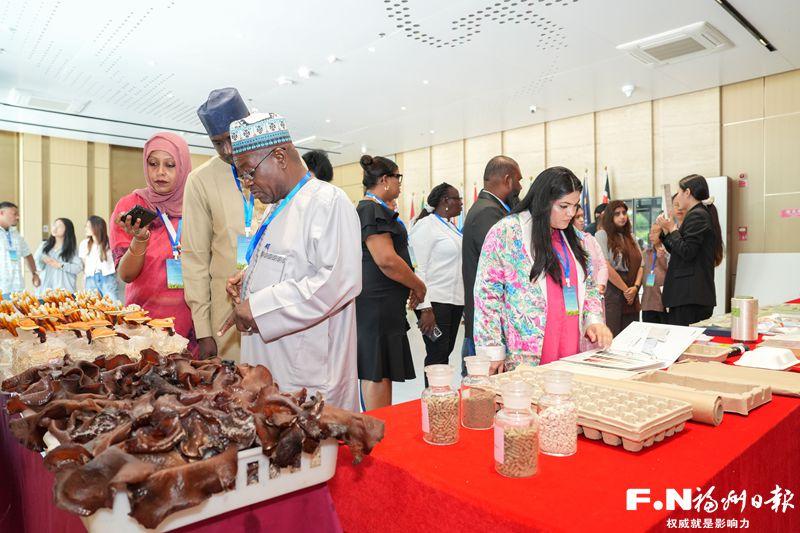
“Juncao is grass of happiness! From the classrooms to the field, from theory to practice, we had a substantial and unforgettable journey in learning Juncao.” On May 21, 2025 International Workshop on Juncao Technology hosted by 21st-Century Maritime Cooperation Committee and organized by the Foreign Affairs Office of Fuzhou Municipal People's Government, the National Engineering Research Center of Juncao Technology, and Fujian Agriculture and Forestry University (FAFU) closed successfully. 24 participants from 15 countries bid farewell to each other with fruitful results.
During the 12-day workshop, the participants learned about the cultivation and management of Juncao under the guidance of lecturers from the National Engineering Research Center of Juncao Technology. On the International Conference on Juncao Industry Development, they discussed the extensive application of Juncao technology in food security, ecological governance, and clean energy. During the visit to Three Lanes and Seven Alleys, Yantaishan Historical District, and Kuliang Tourist Resort, they experienced the historical changes of Fuzhou.
“Learning technology,” “acquire knowledge,” “meet new friends,” “falling in love with Fuzhou”……These words are on the lips of the participants.
“Jakarta has limited agricultural land and faces serious environmental issues. Juncao technology provides an innovative solution to our problems,” said Imam Fitrianto, Head of Marine Division of Food Security, Marine and Agriculture Agency of Jakarta Capital City Government. “If well implemented, it may be an important drive to inclusive and sustainable development of Jakarta.”
Dineshi Chandrarathna Kariyapperuma Mudiyanselage, Municipal Secretary of Kurunegala Municipal Council said, “With the help of the platform, we acquired the practical experiences of Juncao cultivation, which can increase the income of farmers. I would like to express my thanks to 21st-Century Maritime Cooperation Committee and the National Engineering Research Center of Juncao Technology. I hope they can continue to host the workshop and help more countries seek sustainable development.”
“Fuzhou is great!” said Yassir Abdullahi Jobe, Vice Chairman of Gaya Local Government Area. He said that the historical architecture in Fuzhou left deep impression on him. He took lots of photos and would introduce the beautiful city to Nigerian people.
“Juncao is not only the theme of the workshop, but also a bond connecting us. The closing of the workshop is not an end, but a new start,” said the leader from Fuzhou Foreign Affairs Office. “I hope that the Juncao technology can be brought back to your countries and put into practice to yield fruitful results. I also hope that the friendship we established during these days can last forever, becoming bridges that connect us.”
The charm of a city lies in its inclusiveness. The value of a technology lies in the benefits it brings to people. From sharing poverty alleviation experience, promoting South-South cooperation to jointly developing the “Belt and Road” and advancing global green development, the essence of building a human community with a shared future becomes clearer in sustained efforts.
Source: Fuzhou Daily

On May 10, the 2025 International Workshop on Juncao Technology officially commenced in Fuzhou. The event is hosted by the 21st-Century Maritime Cooperation Committee and co-organized by the Foreign Affairs Office of Fuzhou Municipal People’s Government and the National Engineering Research Center of Juncao Technology, FAFU. This marks the third consecutive year that the Committee has organized an international workshop to promote Juncao technology. This year’s edition has attracted 24 participants from 15 countries, including members of the Committee, representatives from Fuzhou’s friendship cities, and delegates from South Pacific nations. As one of the Committee’s flagship programs for the year, this workshop highlights the multifaceted value of Juncao technology in promoting global food security, green transition, and sustainable development, while showcasing the real-world application of China’s agricultural science and technology around the globe.
Juncao Technology as a Carrier for Advancing International Green Development Cooperation
Juncao technology, an original Chinese innovation and globally shared green technology, originated in Fujian in the 1990s and has since been introduced to 107 countries and regions. It has become a valuable tool for many countries to address ecological degradation and poverty through locally adapted solutions. During this workshop, participants will engage in in-depth discussions on the application of Juncao technology in areas such as agricultural productivity, ecological restoration, and bioenergy. The program includes technical briefings, case studies, hands-on training, and site visits, all emphasizing practical cooperation in the field of green development.
A Multilateral Platform for Promoting Global and Regional Agricultural Sustainability
Since its establishment at the Belt and Road Forum for International Cooperation in 2017, the 21st-Century Maritime Cooperation Committee has served as a Belt and Road initiative to foster people-to-people connectivity. The Committee has been dedicated to building an inclusive, multilateral, and sustainable cooperation network to deepen collaboration among member cities and regions in marine economy, agricultural technology, and ecological governance. Especially in the promotion of Juncao technology, the Committee has held annual workshops to disseminate knowledge, share standardize technology, and enable more countries and regions to benefit from Fuzhou’s experience in sustainable agriculture.
During this workshop, participants will also visit Fuzhou’s Juncao research base, edible mushroom equipment manufacturers, and cultural landmarks such as the Three Lanes and Seven Alleys Historic and Cultural District and Guling, gaining firsthand insight into Fuzhou’s achievements in green development and cultural heritage preservation.
The Workshop is not only a platform for professional and technical exchanges, but also a channel for promoting the concept of green development. The 21st-Century Maritime Cooperation Committee will continue to foster pragmatic cooperation with its member cities and regions, transforming the “small Juncao” into a new engine for “big cooperation,” and contributing to the joint creation of a cleaner, more beautiful, and prosperous world.
Source: 21CMCC
"Beyond learning technology and making friends, this workshop on Juncao technology has also broadened my horizons and increased my knowledge."
"Will there be another event like this next year? Be sure to send us an invitation."
"I will bring the beauty and friendliness of Fuzhou back to the South Pacific"
……
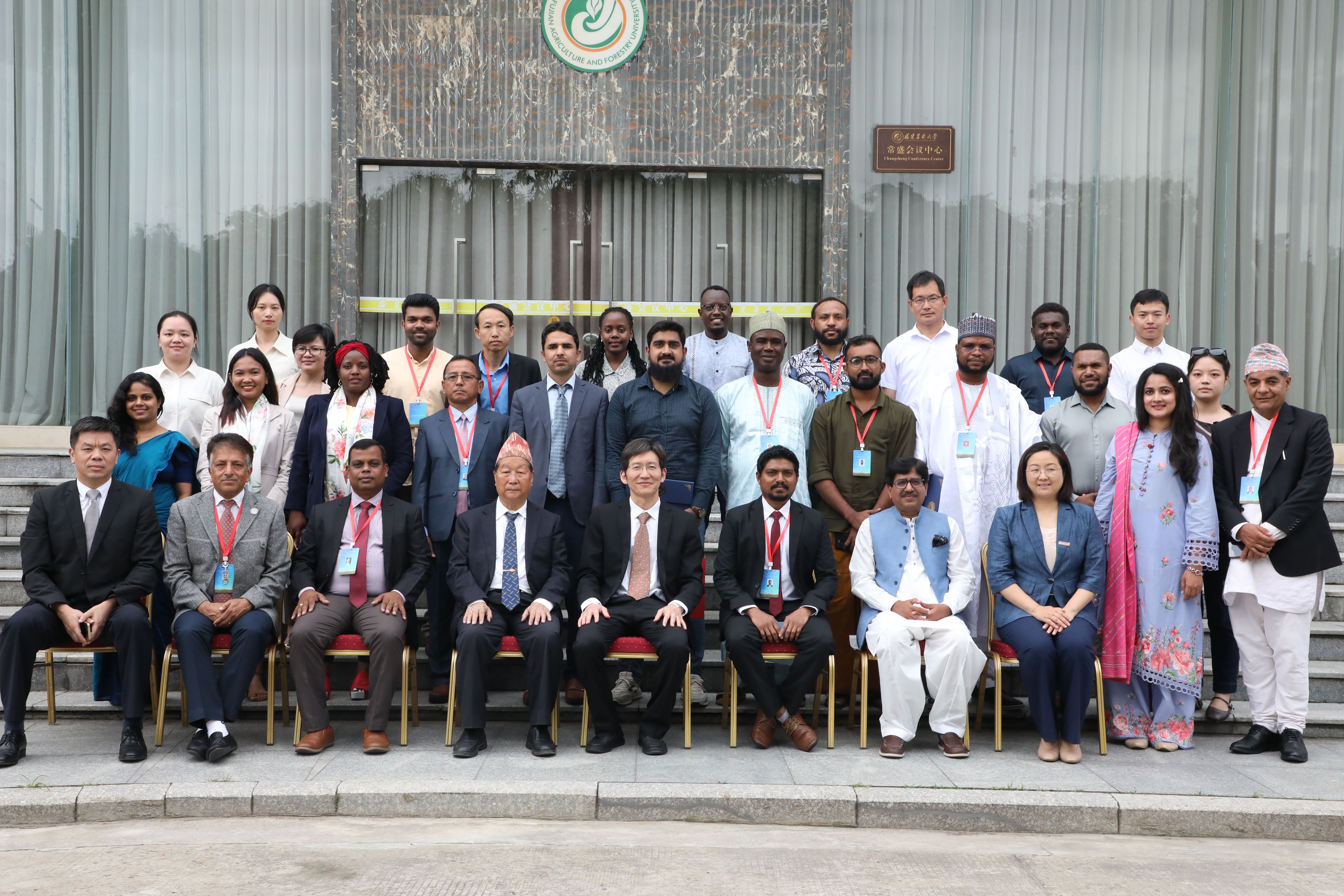
On the afternoon of May 27th, the atmosphere was lively in the venue of the National Engineering Research Center of Juncao Technology, Fujian Agriculture and Forestry University(FAFU). 22 representatives from 12 countries, including member representatives of the 21st-Century Maritime Cooperation Committee and friends from South Pacific countries, were reluctant to part and said goodbye to each other.
On May 16th, the Workshop kicked off in Fuzhou. The event was sponsored by the 21st-Century Maritime Cooperation Committee and organized by the Foreign Affairs Office of Fuzhou Municipal People's Government and the National Juncao Engineering Research Center of Juncao Technology, Fujian Agriculture and Forestry University (FAFU). It aims to promote Juncao technology among the members of the Committee and South Pacific countries by introducing basic knowledge of edible and medicinal mushrooms, Juncao cultivation and management, discussing the wide application of Juncao technology in food security, ecological governance, clean energy, etc., and sharing the achievements of Fuzhou's sustainable agricultural development. The workshop will deepen cooperation among member cities in the field of green development, make Juncao technology benefit more countries and people, and further enhance the international popularity and influence of the Committee and Fuzhou.
Based on the characteristics of member cities of the Committee and the South Pacific countries, the National Engineering Research Center of Juncao Technology specially designed a teaching plan for the Workshop, including 11 condensed professional lectures, covering cultivation of pleurotus ostreatus with Juncao technology, cultivation of lentinus edodes with Juncao technology, application of Juncao technology in ecological conservation, Juncao technology international cooperation and sustainable development, etc.. During this event, 3 on-site teaching activities were conducted on the cultivation of edible and medicinal mushrooms with Juncao technology (mixing, bagging and sterilization), cultivation of edible and medicinal mushrooms with Juncao technology (inoculation), and Juncao edible mushroom cooking.
"According to UN guidelines, knowledge sharing is one of the major key factors in achieving the UN's sustainable goals. Moreover, they are recommending that tested and proven knowledge and experience sharing is the most effective way for knowledge sharing." Sri Lankans regard local Juncao varieties as invasive plants and try to remove them, said Ajantha Maninnalage, Municipal Commissioner and Acting Mayor of Kurunegala, Sri Lanka. "Now we know how valuable the plants we are trying to eradicate or destroy from our lands."
"Science knows no boarders and mankind shares a common destiny." Krishna Neupane, Treasurer and Consultant of Institute of Local Governance Studies, Kathmandu, Nepal, said that as a bridge to hope and a platform of ecological cooperation, development and friendship, the road of Juncao technology is extending and the legendary story of this technology is going on and on uniting with the spirit of global cooperation.
During the practice session, the representatives had a great time, either communicating with each other or asking questions enthusiastically, and carefully recorded their feelings of learning. "The advancements in Juncao technology present an unique opportunity for sustainable development. By leveraging this technology, we can address food security, promote environmental sustainability, and create new economic opportunities for our people. I am eager to work with my colleagues and stakeholders in the Maldives to implement what I have learned here." said Ibrahim Abubakuru, Councilor of Male City, Maldives.
In order to broaden the representatives' horizons and enrich their learning experience, the Committee also organized them to visit the Demonstration Base of Juncao Industry for Rural Revitalization in Shunchang County and Demonstration Base of Juncao Wind Prevention and Sand Fixation and other companies and plants. Moreover,they also visited Three Lanes and Seven Alleys Historic District, Yantaishan Historic District, Shangxiahang Historic and Cultural District, Guling Tourist Resort, appreciating the culture of Fuzhou, city of blessings.
"The learning efficiency these days is very high! I am very impressed by the warmth and friendliness of the people of Fuzhou. Fuzhou's many experiences in promoting sustainable development are worth learning." Anwar Hussain, CEO of the Pakistan Association for Development of Local Governance (ADLG), said, "Juncao technology is a great contribution made by the Chinese people to the world and an important technology to ensure global food security. After returning home, we must immediately start to spread those knowledge and skills to our farmers."
"If you want to go fast, go alone. If you want to go far, go together". The 21st-Century Maritime Cooperation Committee aims to promote close exchanges and practical cooperation among its members through a series of events, so that Juncao can become a "Grass of Happiness" that benefits the world. Wu Xiaojie, Executive Deputy Secretary of the Committee and Director of the Foreign Affairs Office of Fuzhou Municipal People's Government, said that he sincerely hopes that all the participants can take the knowledge and experience they learned during this event back to their own countries and regions, and contribute to the promotion of local agricultural development. He also mentioned, "It is my hope that you can introduce Fuzhou and the 21st-Century Maritime Cooperation Committee to the people, government agencies and enterprises of your countries, further deepen our exchanges and cooperation, complement each other's advantages and achieve win-win cooperation."
Source: 21CMCC
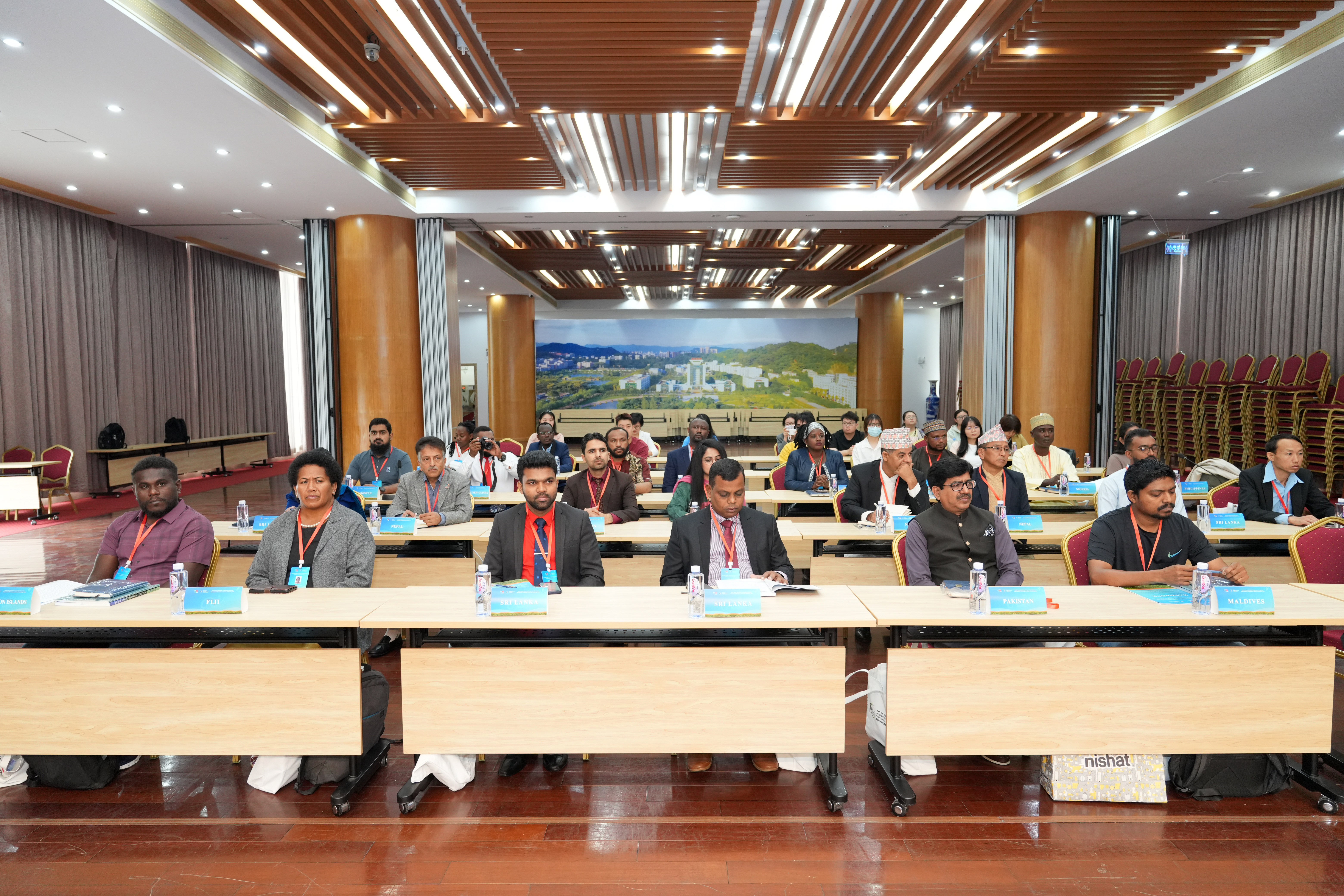
On May 16, 21st-Century Maritime Cooperation Committee International Workshop on Juncao Technology 2024 kicks off in Fujian Agriculture and Forestry University (hereinafter referred to as FAFU). 25 delegates from 12 countries including overseas members of 21st-Century Maritime Cooperation Committee (hereinafter referred to as the Committee) and South Pacific countries participate in the Workshop.
The Workshop, hosted by 21st-Century Maritime Cooperation Committee and organized by the Foreign Affairs Office of Fuzhou Municipal People’s Government and the National Engineering Research Center of Juncao Technology, FAFU, aims to popularize Juncao Technology among members of the Committee, and introduce edible and medicinal mushrooms, as well as the cultivation and management of Juncao grass. The workshop will facilitate exchanges and discussion on the extensive application of Juncao Technology in food security, ecological management, clean energy and other fields. The Workshop will also share the achievements made by the city of Fuzhou in agricultural sustainable development and deepen the cooperation in green development among the members of the Committee, so as to bring benefits to more people and countries, and increase the international popularity and influence of the Committee and Fuzhou City.
The Workshop will last for 12 days till May 27th. During the period, delegates will visit sites such as the Demonstration Base of Juncao Industry for Rural Revitalization in Shunchang County and the Demonstration Base of Juncao Windbreak and Sand Fixation. Delegates will also experience Fuzhou’s culture in the Three Lanes and Seven Alleys, Kuliang Tourist Resort, Yantaishan Historic District, Fuzhou Shangxiahang Historic and Cultural District, better understanding of Fuzhou’s social and economic development and experiencing the unique charm of Fuzhou, the city of blessings.
21st-Century Maritime Cooperation Committee is a standing committee of United Cities and Local Governments Asia-Pacific (hereinafter referred to as UCLG ASPAC), jointly initiated by the Chinese People’s Association for Friendship with Foreign Countries (CPAFFC) and the Fuzhou Municipal People’s Government. It was established after approval in April 2017 at the UCLG ASPAC Executive Bureau Meeting held in Catbalogan, the Philippines. It is a non-profit international organization composed of the members of UCLG and other cities and organizations that accept the Charter of the Committee. The site and the secretariat of the Committee shall be permanently located in Fuzhou, Fujian, China. Since its establishment, 69 cities and organizations of 28 countries from 5 continents have joined the Committee. In May of 2023, the Committee held the first Workshop on Juncao Technology and received a warm response, which has contributed to boosting agricultural sustainable development across the world and regions.
Source: 21st-Century Maritime Cooperation Committee
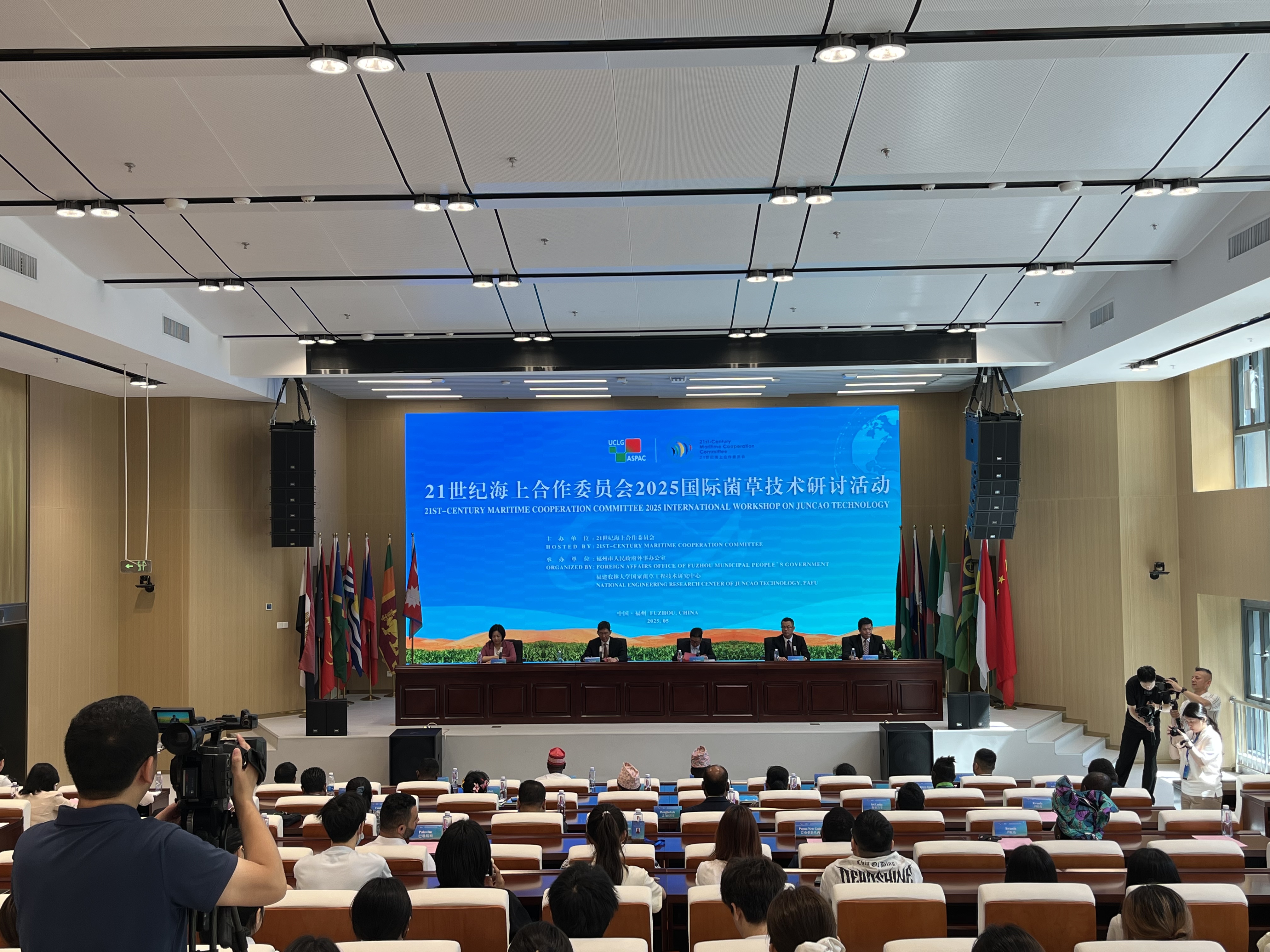
The opening ceremony of the Workshop on Juncao Technology of the 21st Century Maritime Cooperation Committee was held in Fuzhou on May 16th. Representatives from 12 countries, including members of the Committee, Fuzhou’s International Friendship Cities and South Pacific countries, and staff of Foreign Affairs Office of Fuzhou Municipal People’s Government and China National Engineering Research Center of Juncao Technology gathered together to further strengthen international cooperation, improve food production capacity and green sustainable development with Juncao technology as the carrier, making Juncao grass as the “grass of blessing and wealth” for people in developing countries and contributing Chinese wisdom, Chinese solution and Chinese strength to the implementation of the UN 2030 Sustainable Development Agenda. The 10-day event will last until May 25th.
Juncao is honored as China’s gift to the world. President Xi attaches great importance to the international cooperation in Juncao technology. When he was in Fujian, he introduced the Juncao technology to Papua New Guinea. After more than 20 years, Juncao has taken root in 106 countries and regions. It has played an important role in enhancing the development and well-being of the local people, craved a new path to increase job opportunities, eliminate poverty, and promote sustainable development, becoming one of the key projects of China to help developing countries achieve the sustainable development goals.
The workshop is jointly hosted by the 21st-Century Maritime Cooperation Committee and Fuzhou Municipal People’s Government and organized by the Foreign Affairs Office of Fuzhou Municipal People’s Government and Fujian Agriculture and Forestry University. It is carried out in the form of classroom lectures, cultural experiences, on-site teaching and visits to introduce edible and medicinal mushrooms, the cultivation and management of Juncao grass, and the utilization of Juncao technology. The extensive use of Juncao technology in food security, ecological management and clean energy will be discussed to deepen the cooperation of members in promoting green development. The organizer will issue certificates of completion to the participants who attend the workshop.
During the event, the guests will also visit Yantaishan Historic District, Shangxiahang Historic and Cultural District, Shipyard Museum and other places to learn more about the current economic and social development of Fuzhou, a famous national historic and cultural city.
Du Weiguang, Deputy Director of Foreign Affairs Office of Fuzhou Municipal People’s Government and Deputy Secretary General of the 21st-Century Maritime Cooperation Committee, pointed out that Fuzhou is among the first batch of coastal cities opening to the outside world with long history and unique marine culture. Fuzhou has yielded fruitful outcomes by adhering to the ideological essence of “Vision 3820” Strategic Plan and by making a grand development blue print to advance the construction of marine Fuzhou during the past thirty plus years. Since its unveiling as a result for people-to-people connectivity at the first Belt and Road Forum for International Cooperation in 2017, the 21st Century Maritime Cooperation Committee has become an important platform for maritime cooperation between countries and regions that jointly build the “Belt and Road Initiative” by actively organizing various brand activities of the Committee and deepening close contact and exchanges with its members.
Source: Fuzhou Broadcast and Television



OFFICIAL WECHAT
Email:
secretariat_21cmcc@163.com
Telephone:
+86-591-83532970
+86-591-83533101
Fax:
+86-591-83531520
Address:
Room 728, Building 3, Eastern Municipal Government Office Compound, 193 South Riverside West Avenue, Cangshan District, Fuzhou City, Fujian Province, China
Set As Default Home Page|Add To Favorites|CONTACT US
Copyright: © 21st-Century Maritime Cooperation Committee Public security record number:35010402351060 闽ICP备2020019451号
