


Your current location:Home > Events > Workshop on Marine Issues


 TIME:2026-05-13 18:55


Marking the fourth consecutive year the Committee has organized an international workshop to promote Juncao technology, the program has attracted 20 delegates from nine nations, including foreign members of the Committee, representatives from Fuzhou’s friendship cities, and delegates from South Pacific nations. Gathered in the “City of Blessings”, participants will use Juncao as a bridge to share their vision for green development and strengthen bonds of friendship.
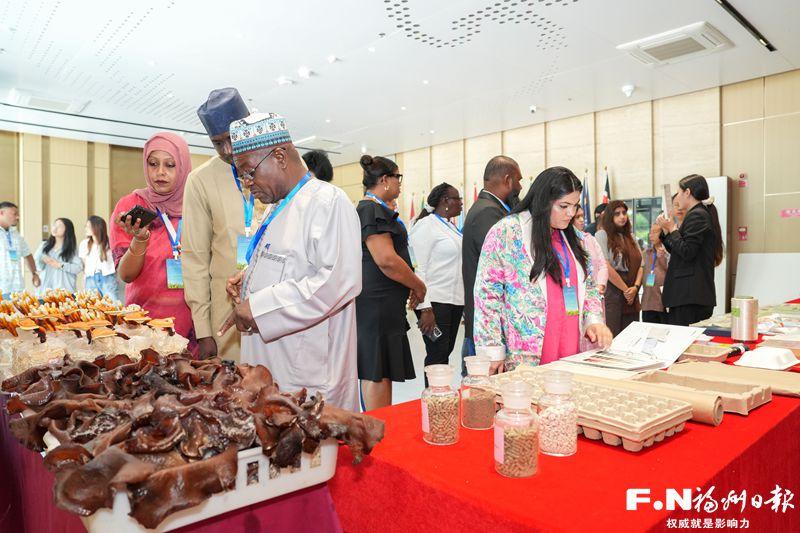
Juncao as a Medium: The “China Solution” Benefits the World
This year marks the 40th anniversary of the invention of Juncao technology. In 1986, Lin Zhanxi, Chief Scientist of the National Engineering Research Center of Juncao technology and professor at FAFU, invented the technology in Fujian Province, achieving the groundbreaking substitution of grass for wood in mushroom cultivation. During his tenure in Fujian in the 1990s, President Xi Jinping spoke highly of Juncao technology and personally promoted its development. Since then, he has continued to support the application of Juncao technology across developing countries. Today, this “China Grass” has taken root in 108 countries, serving as a hallmark of China’s foreign aid and global poverty reduction efforts, as well as a practical initiative supporting implementation of the UN 2030 Agenda for Sustainable Development.
As a specialized committee within the framework of the United Cities and Local Governments Asia-Pacific, the 21st-Century Maritime Cooperation Committee is committed to building an important platform for maritime cooperation under the Belt and Road Initiative. The Committee now comprises 80 members from 29 countries. Since 2023, it has organized four consecutive international workshops on Juncao technology, training nearly 100 technical professionals from 19 countries and continuously deepening cooperation in agricultural technology, ecological governance, and green development. These efforts have gradually built a “Juncao cooperation network” spanning the South Pacific and extending across the globe.
Relevant official of the Foreign Affairs Office of Fuzhou Municipal People’s Government, said that participants had traveled great distances to Fuzhou not only to learn technology, but also to foster friendship and cooperation. He expressed hope that participants would make full use of the learning opportunity, gain a deep understanding of Juncao technology through lectures and field practices, and bring this “path to prosperity” back to their home countries to support agricultural development and improve people’s livelihoods. He also encouraged participants to deepen mutual understanding through exchanges and become bridges for friendly relations between their countries and Fuzhou.
Integrating Theory and Practice to Explore the Full Juncao Industry Chain
The 11-day workshop combines thematic lectures, on-site teaching, field visits, and discussion sessions to help participants gain a systematic understanding of the full industrial chain of Juncao technology applications.
Following the opening ceremony on May 12, participants will first attend lectures on topics including “Current Development and Application Prospects of Juncao Technology,” while also learning about China’s development experience through courses on China’s national conditions.
In the following days, courses will focus on high-yield and high-quality Juncao cultivation management, ecological governance and low-carbon circular development, Juncao-based livestock breeding technology, the use of Juncao as animal feed, and oyster mushroom cultivation using Juncao technology.
During practical training sessions, participants will visit the National Engineering Research Center of Juncao Technology to study key technical procedures including Juncao planting, edible and medicinal mushroom cultivation techniques, substrate mixing and bagging, sterilization, and inoculation. They will also take part in hands-on activities such as cooking with Juncao-grown edible mushrooms.
In addition to classroom instruction, the program also includes several field visits. On May 15, participants will visit an edible mushroom demonstration base in Youxi County, Sanming, to observe the application of Juncao technology in industrial development. On May 19, they will visit a Juncao-based livestock breeding demonstration base in Fuzhou to gain deeper insight into the technology’s applications in animal husbandry.
On May 20, the event will conclude with a symposium on international Juncao industry development, during which representatives will share their learning experiences and exchange development practices, followed by a graduation ceremony that afternoon.
Cultural Exchange Adds New Chapter to the Maritime Silk Road Story
Alongside technical exchanges, the event also features a special “Mindu Cultural Tour,” allowing participants to experience Fuzhou’s rich historical heritage and ecological urban charm.
Participants will visit landmarks such as Three Lanes and Seven Alleys, the Yantaishan Historic and Cultural District, and the Fudao Skywalk, immersing themselves in the city’s traditional architecture, urban landscape, and ecological development achievements.
As a pivotal gateway city on the Maritime Silk Road, Fuzhou has long served as a key window for China’s opening-up. Today, the city continues to expand its international partnerships and deepen exchanges and cooperation in trade, culture, and ecological development. In 2025, Fuzhou’s GDP exceeded 1.5 trillion yuan, with its ecological strengths and open, inclusive vitality becoming increasingly prominent.
“Fuzhou is a city with both profound historical heritage and vibrant modern energy,” many participants remarked upon arriving in the city. Representatives from countries including Fiji, Kenya, and Trinidad and Tobago said they hoped to bring Fuzhou’s green development experience and Juncao technology back to their home countries, enabling this “grass of happiness” to take root locally and create new opportunities for agricultural development, ecological governance, and livelihood improvement.
From a single blade of grass born in Fujian four decades ago to today’s “grass of happiness” that connects the world, Juncao technology continues to build bridges of friendship and cooperation between China and the world, while contributing vivid green chapters to high-quality Belt and Road cooperation.
Source: Fuzhou Daily


OFFICIAL WECHAT
Email:
secretariat_21cmcc@163.com
Telephone:
+86-591-83532970
+86-591-83533101
Fax:
+86-591-83531520
Address:
Room 728, Building 3, Eastern Municipal Government Office Compound, 193 South Riverside West Avenue, Cangshan District, Fuzhou City, Fujian Province, China
Set As Default Home Page|Add To Favorites|CONTACT US
Copyright: © 21st-Century Maritime Cooperation Committee Public security record number:35010402351060 闽ICP备2020019451号
 Close
Close File:
File: